Building on the patient safety evidence reviewed in part 1, this second article examines the economic implications of residual neuromuscular blockade, focusing on how inconsistent monitoring contributes to avoidable postoperative complications and institutional cost.
Phase 2 & 3: The True Cost of Inconsistent Monitoring
In the second and third phases of the study, the authors examined institutional National Surgical Quality Improvement Program (NSQIP) data and internal cost accounting records to evaluate downstream consequences.
Their analysis found that:
- Postoperative pneumonia or unplanned reintubation occurred in 4.2% of general endotracheal anesthesia cases.
- The average marginal cost associated with a pulmonary complication was $36,372 per patient.
- On an annual basis, these events accounted for approximately $6.9 million in institutional cost.
These costs reflect prolonged hospitalization, increased ICU utilization, and additional staffing and treatment requirements. While such complications occur in a minority of patients, their financial and clinical impact is outsized.
Crucially, these costs are tied directly to patient safety. They arise precisely because compromised neuromuscular recovery increases vulnerability during the postoperative period. What harms patients also strains hospital resources.
Why Universal Protocols Change the Economics
The most powerful insight of the study is not just that QNM improves outcomes—but that scale and compliance deliver significant economic value.
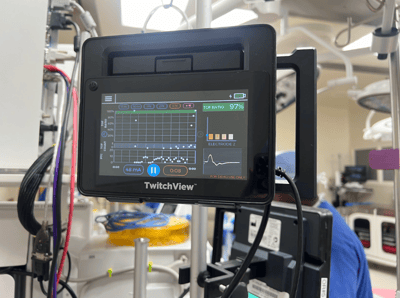
To assess whether universal QNM could plausibly offset its own cost, the authors modeled implementation of the TwitchView Train of Four Monitor across all applicable cases at Temple University Hospital.
Key findings from the sensitivity analysis included:
- The projected annual cost of universal monitoring was modest relative to the complication-related expenses it was intended to reduce.
- Preventing as few as five major pulmonary complications per year (approximately 2.6% of expected events) would allow the program to break even.
- Under conservative assumptions, potential annual savings approached $4.6 million.
The authors emphasize that the economic benefit was robust across a wide range of assumed reductions in complication rates, reinforcing that the financial case does not depend on the complete elimination of residual paralysis.
Aligning Safety and Stewardship
For hospitals and anesthesia departments, residual paralysis occupies a critical intersection between clinical quality and operational stewardship. Preventing avoidable pulmonary complications protects patients first—but it also reduces length of stay, ICU utilization, and the cascading costs associated with postoperative respiratory failure.
Addressing residual paralysis therefore supports:
- Safer extubation and recovery
- More reliable perioperative care
- Better alignment between quality goals and cost containment
Patient safety and economic responsibility are not competing priorities in this context. They are linked by the same underlying clinical reality: incomplete neuromuscular recovery places patients at risk.
Technology Alone Is Not the Solution
The study also delivers an important operational message: simply purchasing monitors does not guarantee results.
To realize both safety and economic benefits, institutions must:
- Standardize QNM use for all patients receiving non-depolarizing neuromuscular blockers
- Embed protocols that require objective confirmation of recovery (TOFR ≥ 0.9) prior to extubation
- Track compliance metrics, not just complication rates
- Educate clinicians on the limitations of qualitative monitoring and the interpretation of quantitative data
Without these steps, QNM becomes inconsistent—and inconsistently used safety tools rarely move safety outcomes or budgets at scale.
The Takeaway
The economic case for quantitative neuromuscular monitoring is no longer theoretical. Independent data now shows that:
- Residual paralysis drives avoidable cost
- Partial adoption limits impact
- Universal, protocolized monitoring delivers both safety and savings
In anesthesia, what gets measured gets managed. And when monitoring is applied at scale, the value follows.
Stay tuned for the third review where the focus shifts from evidence and economics to implementation.