
Evidence that sugammadex without quantitative monitoring is not safe.

I’m joined in this post by Dr. Srdjan Jelacic, Professor of Anesthesiology at the University of Washington.
Generic sugammadex has arrived in the United States and is substantially less expensive than Bridion, the Merck brand-named product. This is certainly a positive development and will undoubtedly lead to more widespread use of sugammadex. Since sugammadex is a substantially more capable reversal agent than neostigmine, which is reliable only for reversing shallow block (train-of-four ratio > 0.4), increased use of sugammadex is likely to reduce the incidence of residual neuromuscular block.
Some people have the impression that by simply using sugammadex, without quantitative monitoring, residual neuromuscular block can be eliminated. Unfortunately, this is not correct. We have posted previously about the limitations in the effectiveness of sugammadex (“Sugammadex is not a silver bullet”—a podcast with Dr. Mike Todd and “Sugammadex is not a silver bullet revisited”). Residual neuromuscular block can occur following the recommended dosing regimen for sugammadex (2 mg/kg if train-of-four count 2 or more, 4 mg/kg if train-of-four count 1 or less and PTC >0), and even in some cases when very large doses of sugammadex are administered.
Let’s briefly review the evidence. While this is somewhat a repetition of our previous posts on this topic, it’s worth looking at this again in the context of inexpensive, generic sugammadex.
One of the earliest studies to document failure of adequate reversal with sugammadex was Kotake et al, published in 2013. This was a multi-center study in which either neostigmine or sugammadex was administered for reversal of rocuronium, without the use of quantitative twitch monitoring. Following extubation, the train-of-four ratio was measured with acceleromyography, which was not normalized (since there were no baseline, unparalyzed train-of-four measurements with which to perform normalization). Sugammadex 2 mg/kg was administered if there was bucking against the endotracheal tube, spontaneous breathing, or movement of extremities were noted. If these signs were not present, 4 mg/kg sugammadex was administered. The average dose of sugammadex was 2.7 mg/kg. In all cases, patients were kept under observation until their train-of-four ratio was 0.9 or greater. The incidence of train-of-four ratio of less than 0.9 following sugammadex administration was 4.3% and the incidence of train-of-four ratio less than 1.0 was 46%. Since baseline train-of-four ratio >1.0 (and as high as 1.6) is commonly seen when using acceleromyography (and is the reason that normalization should be performed), using a train-of-four ratio of at least 1.0 as the goal for reversal with acceleromyography has been recommended by some authorities, although even a train-of-four ratio of 1.0 may not exclude residual neuromuscular block using acceleromyography (see our post, “It’s time to say goodbye to acceleromyography”). Using a train-of-four ratio of 1.0 as the threshold value for residual neuromuscular block, nearly half of the patients in this study, who received 2 mg/kg or 4 mg/kg of sugammadex had residual neuromuscular block.
We performed a study that involved titration of sugammadex in 50 mg increments until a train-of-four ratio of at least 0.9 was measured by electromyography. We found that 13% of patients required more than the recommended dose of sugammadex. These results are compatible with the results of Kotake et al. A similar titration study performed by Gao et al obtained results similar to our study.
It’s important to remember that there is no recommended dose of sugammadex when the post tetanic count is 0. This is because it’s impossible to know how “deep” the block is at a post tetanic count of 0, which represents essentially the lower limit of sensitivity of the post tetanic count “assay” for neuromuscular block.
Although we hesitate to even suggest using sugammadex without neuromuscular block monitoring, let’s pose the question of whether we could simply give every patient a very large dose of sugammadex and dispense with monitoring. If sugammadex were inexpensive enough, and since there are probably no dose-related side effects of sugammadex, this might not be an entirely outrageous suggestion. But, there are a couple of problems with this approach. First, we probably don’t have enough data to determine what an appropriate “very large dose” of sugammadex would be. Would it be 5, 6, 7, 8 or even more mg/kg? It would have to be large enough to include all of the sugammadex response outliers. In our study of 97 patients (which would be underpowered for this purpose), it appears the dose needed to include all of the patients would be around 6 mg/kg. We have also looked retrospectively at approximately 41,000 cases of sugammadex administration in our institution, monitored with electromyography, and found a substantial number who received at least 10 mg/kg of sugammadex (Haththotuwegama et al, A Retrospective Cohort Study of Patients with Reduced Clinical Response to Sugammadex, AUA 2026 Annual Meeting, Seattle WA).
Another problem with simply giving a very large dose of sugammadex is that there is some evidence for patients who cannot be reversed even with very large doses sugammadex, for reasons that are entirely unknown. A case report documented a patient with a train-of-four count of 1 at the end of surgery who received 9.7 mg/kg of sugammadex, without any measurable change in the train-of-four. The package insert for sugammadex (Merck) states that during clinical trials of sugammadex, there were patients who had “delayed or incomplete” responses to sugammadex. While patients who are “resistant” to sugammadex are probably rare, we don’t really know how frequently this occurs.
Some people may say not to worry about the outliers, that getting the desired result in most of the patients is good enough. In our opinion, anesthesia providers are in the business of preventing relatively rare complications. Anesthesia is remarkably safe, so getting a good result in most of the patients is a very low bar. The bar should be much higher. We should aim to get good results in ALL of the patients. Getting a good result every time is the hallmark of highly reliable industries like commercial aviation. That is where we should be.
In addition, we have a philosophical problem with a pharmacologic approach in which patients are deliberately overdosed (or underdosed) with rocuronium and then overdosed (or underdosed) with sugammadex, without actually measuring the effects of either drug. This is not precision medicine. This is not individualized medicine. We have the capability to accurately measure the effects of the drugs we use and we should be doing so. We should be adjusting anesthetic drug administration to fit individual surgical situations and individual patient needs. Quantitative neuromuscular block monitoring gives us the capability to adjust the degree of muscle relaxation throughout an anesthetic, not only to document adequate reversal at the end of the anesthetic.
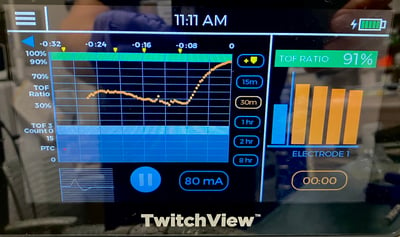
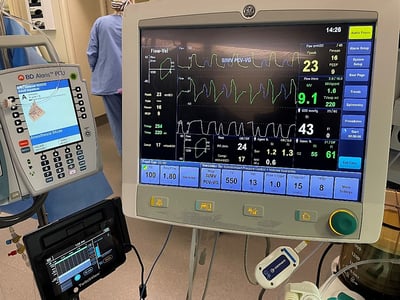
It’s worth a reminder that monitoring has to be quantitative. Qualitative monitoring (palpating twitches produced with a peripheral nerve stimulator) does not reliably prevent residual neuromuscular block, whether neostigmine or sugammadex is used for reversal. A useful study demonstrating the total prevention of residual neuromuscular block with neostigmine or sugammadex guided by electromyographic quantitative monitoring can be found here. And don’t even think about using a nerve stimulator on periorbital muscles, as we discussed in a recent post.
Inexpensive generic sugammadex is a very positive development, but sugammadex cannot be used safely and effectively without the use of quantitative neuromuscular block monitoring. Simply giving the recommended dose of 2 or 4 mg/kg based on the train-of-four count, without quantitative neuromuscular block monitoring will result in a substantial incidence of residual neuromuscular blockade. There is no reasonable single dose of sugammadex that can be relied upon to produce adequate reversal in every patient without confirmation from quantitative monitoring. We have made these points before and cheap sugammadex has not changed our position.