In the final article of this clinical review, the focus shifts from evidence and economics to implementation—specifically, how training, workflow design, and team support determine whether quantitative neuromuscular monitoring becomes a reliable standard of care rather than an optional tool.
Training and Team Support: Making Quantitative Monitoring a Reliable Standard
A consistent theme in the Edwards study is that universal quantitative neuromuscular monitoring is not simply a purchasing decision, but an implementation challenge. The modeled clinical and economic benefits depend on reliable use across providers, rooms, and case types. Achieving this reliability requires deliberate investment in training, workflow integration, and shared expectations.
Education Must Address Both Why and How
Effective training begins with a shared clinical rationale. For clinicians accustomed to qualitative assessment, education should focus on:
- The physiological implications of residual neuromuscular blockade at TOFR values below 0.9
- The known limitations of tactile and visual TOF assessment, even among experienced providers
- How quantitative values complement—rather than replace—clinical judgment
Importantly, education should avoid framing quantitative monitoring as a corrective to poor practice. The Edwards analysis reinforces that residual paralysis arises under routine, well-intentioned care. Training is therefore most effective when positioned as a tool for improving reliability, not clinician performance.
Standardized Placement and Interpretation Reduce Variability
Variation in electrode placement, stimulation site, and interpretation of values can undermine confidence in quantitative data. Early training efforts should therefore emphasize:
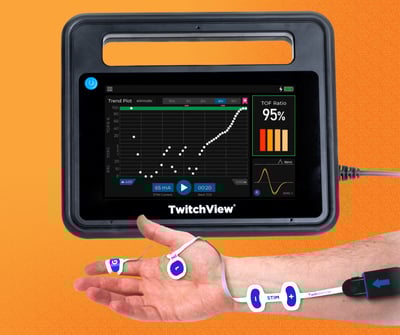
- Consistent selection of monitoring site for recovery decisions (e.g., ulnar nerve/adductor pollicis)
- Clear expectations for supramaximal stimulation and signal quality verification
- Recognition of artifact and conditions that may compromise measurement
When teams share a common mental model of what a reliable signal looks like, trust in the monitor increases and troubleshooting becomes more efficient.
Integrating QNM Into Existing Workflow
Training should reflect how anesthesia teams actually work. Simulation and in-OR coaching are often more effective than didactic sessions alone. Key workflow touchpoints include:
- When quantitative monitoring is applied relative to induction and maintenance
- How data are used to guide reversal decisions
- When recovery is reassessed prior to extubation
- How values are documented or communicated during handoff
By embedding quantitative monitoring into familiar decision points, teams are more likely to adopt it consistently rather than view it as an additional task.
Role Clarity and Team-Based Adoption
Successful implementation typically involves more than anesthesiologists alone. Anesthesia technicians, CRNAs, residents, and PACU staff all play a role in setup, monitoring continuity, and interpretation of recovery.
Clear role delineation helps prevent gaps in use:
- Who ensures the electrodes are placed correctly?
- Who verifies recovery criteria before extubation?
- Who assesses adequacy of recovery in the PACU?
When responsibilities are shared and explicit, quantitative monitoring becomes part of routine care rather than dependent on individual enthusiasm.
Ongoing Feedback and Reinforcement
The Edwards study highlights the importance of tracking compliance, not just outcomes. Institutions adopting quantitative monitoring as a standard of care benefit from simple feedback loops, such as:
- Periodic review of documented TOFR at extubation
- Informal audits of monitor utilization by case type
- Discussion of cases where quantitative data altered management
These reviews are most effective when framed as learning opportunities rather than enforcement mechanisms. Over time, they reinforce normative use and sustain adoption beyond the initial rollout phase.
From Training to Culture
Ultimately, training and support determine whether quantitative neuromuscular monitoring becomes a transient initiative or a durable standard. The Edwards analysis suggests that the value of quantitative monitoring emerges when its use is expected, supported, and normalized.
When teams are trained not only on device operation but on clinical interpretation and shared recovery goals, quantitative monitoring evolves from a new technology into a routine safeguard—one that supports safer emergence, reduces variability, and aligns daily practice with established evidence.