.jpg?width=1920&height=1920&name=image%20(1).jpg)
Incomplete reversal and recurrent neuromuscular blockade can occur for reasons that we don’t actually understand.

A recently published guideline from the Society of Critical Care Medicine does not recommend monitoring neuromuscular blockade in the intensive care unit
I am joined in this post by Drs. Srdjan Jelacic and Peter Von Homeyer of the University of Washington. Dr. Von Homeyer is the Chief of the Division of Cardiothoracic Anesthesiolgy and is a critical care physician.
Patients who are intubated and ventilated in the ICU sometimes receive paralysis to facilitate ventilation. A recently published guideline from the Society of Critical Care Medicine addresses various aspects of neuromuscular block in patients who are ventilated for treatment of Acute Respiratory Distress Syndrome (ARDS).
We want to focus on just one of the recommendations of this guideline. The authors state—”We suggest using either a fixed-dose strategy without monitoring depth of neuromuscular blockade [emphasis is ours], or a titration-based strategy by monitoring depth of neuromuscular blockade for adults with ARDS”. Administration of neuromuscular blocking drugs without quantitative neuromuscular block monitoring is against the recommendations of the anesthesia society guidelines, from every corner of the globe. So the Society of Critical Care Medicine guideline authors support a different standard of care in the ICU than in the anesthesia setting. Is this a good idea?
Let’s start by understanding why anesthesia professional society guidelines recommend against using neuromuscular blocking drugs without quantitative monitoring. The first reason is to avoid extubating patients while they are still paralyzed, usually referred to as “residual neuromuscular blockade”. The potential harm from extubating patients with residual neuromuscular blockade is substantial and well worth avoiding. This applies in the ICU as well as the OR. Another reason to monitor neuromuscular blockade is for assistance in titrating the depth of paralysis when neuromuscular blocking drugs are being administered to achieve specific goals. In the operating room, patients are paralyzed to facilitate intubation, to provide muscle relaxation for surgical exposure, and to prevent movement in response to surgical stimulation. These specific goals are typically met by using a combination of anesthetic drugs and neuromuscular blocking drugs, each of which contributes to muscle relaxation and immobility.
In a previous post, we discussed the pharmacology of preventing movement during surgery. We emphasized that depth of neuromuscular blockade should not be considered in isolation, without also considering the depth of anesthesia. We also emphasized that opioids are particularly effective for preventing movement during surgery. However, while bearing the depth of anesthesia in mind, studies have identified a particular depth of neuromuscular block with useful clinical correlates. Dhonneur et al and Fernando et al have shown that reliably preventing movement of the diaphragm in response to surgical stimulation requires quite deep paralysis (the diaphragm is relatively resistant to neuromuscular block), corresponding to a post tetanic count of about 0-5. This information may be particularly useful in the ICU when using a neuromuscular blocking drug to prevent “dyssynchrony” between the mechanical ventilator and the patient’s spontaneous efforts to breath.
There is an additional reason to measure the depth of neuromuscular blockade in the ICU that seldom if ever applies in the operating room, which is the evaluation of neurologic function. Since the clearance of neuromuscular blocking drugs shows considerable variation from patient to patient, it’s impossible to know with any precision the depth of neuromuscular block after discontinuing or reducing the dose of the blocking drug, without monitoring. Quantitative monitoring allows for precise knowledge of the depth of block. Thus it facilitates meaningful evaluation of neurologic function that is not confounded by a neuromuscular blocking drug.
Prior to the current era of easy-to-use quantitative neuromuscular block monitoring, most twitch monitoring in the ICU was done with subjective monitoring (a nerve stimulator and manual palpation of the twitch). This would have been a substantial obstacle to routine monitoring, since subjective monitoring requires some knowledge and practice to count twitches and determine whether fade is present or not. So it’s not terribly surprising that this was not done regularly in many ICUs. However, the use of electromyography-based twitch monitoring is relatively simple by comparison.
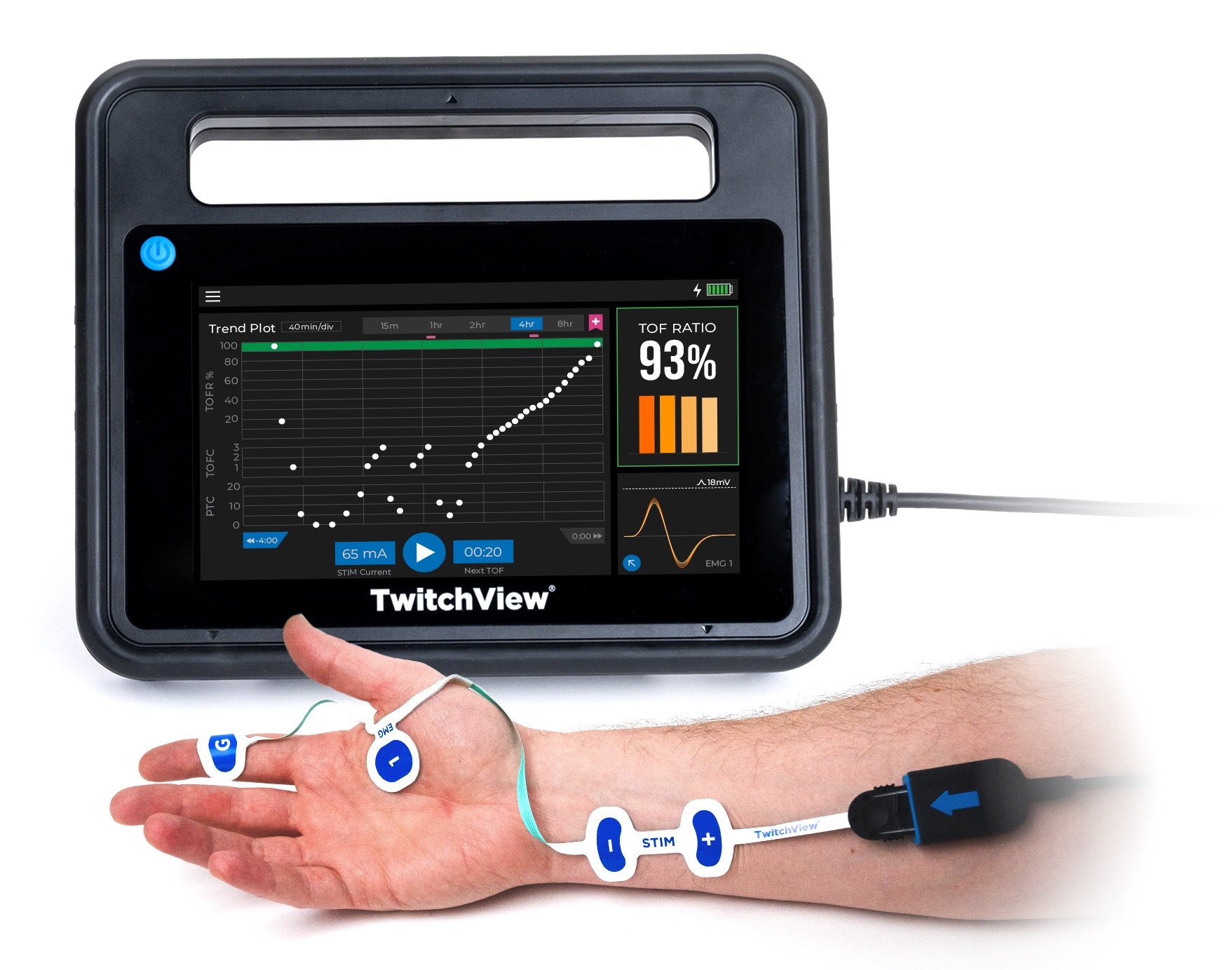
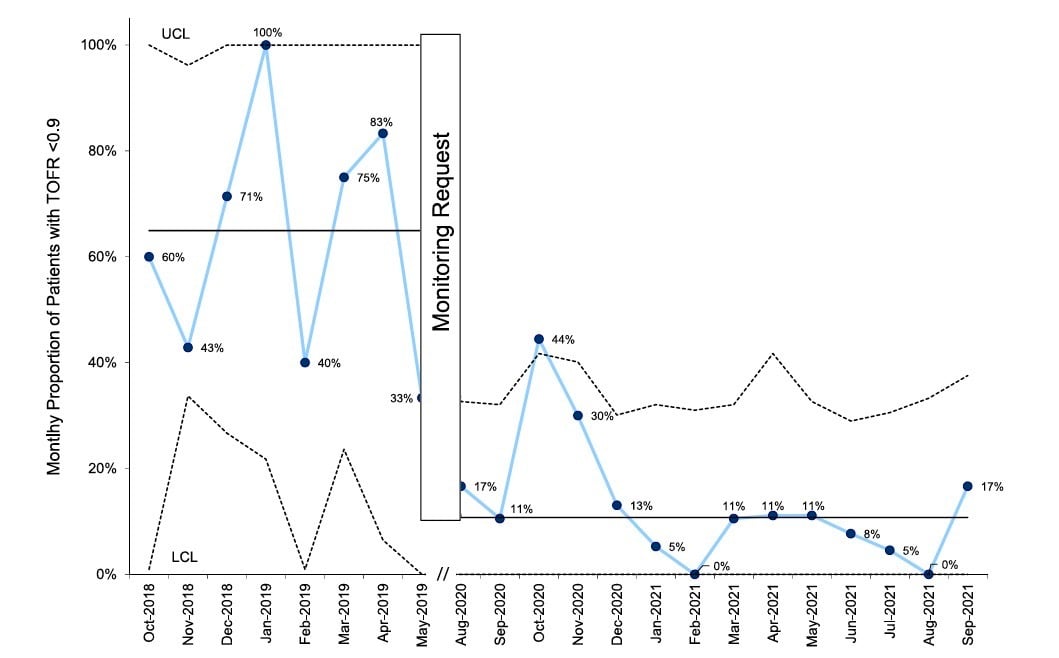
We have demonstrated this by training our respiratory therapists to perform routine electromyography-based twitch monitoring in our ICU. We did this as part of a project to promote fast-track extubation of cardiac surgery patients while avoiding residual neuromuscular block. We published a report that can be found here. The main results are illustrated in Figure 2. We demonstrated that most cardiac surgery patients in our institution were arriving in the ICU with train-of-four ratios <0.9. Following an intervention that encouraged neuromuscular block monitoring in the ICU and administration of reversal agents when indicated, the incidence of paralyzed patients was reduced dramatically. This quality improvement project has had a long-lasting effect, with the respiratory therapists continuing to routinely monitor neuromuscular block in cardiac surgery patients in our ICU.
We have found that respiratory therapists are highly motivated to add twitch monitoring to their repertoire of skills that are so important to our ICU patients. Sometimes electromyographic twitch monitoring requires a bit of troubleshooting, but this is usually relatively simple—we posted our troubleshooting approach here.
Now that easy-to-use quantitative neuromuscular block monitors are readily available, there is really no justification for continuing to administer neuromuscular blocking drugs in the ICU without monitoring. The standard of care in the operating room and the ICU should be the same.